Monday, September 15, 2025

Subculture USA: Peggy Caserta (Mnasidika) & Bellbottom Jeans

Peggy Caserta arrived in San Francisco from Louisiana in the mid-1960s with a mixture of restlessness and an eye for clothes, and by opening the boutique Mnasidika on Haight Street she inserted herself into a small set of people who converted local styles into wider trends. Born in 1940 and later a public figure in accounts of San Francisco’s countercultural quarter, her life has been written about in obituaries and profiles that line up the basic biographical facts — her move from work at Delta Airlines to running a shop at 1510 Haight, her long friendship and romantic relationship with Janis Joplin, her later struggles with addiction, the two memoirs she published and the fact of her death in late 2024 — all of which frame a life that threaded commerce, scene life and caregiving in ways that make the Haight story legible.

The boutique she opened in April 1965 was small, billed at first as an inexpensive storefront around the Doolan-Larson building, but it quickly developed the pattern that would knot place and style together: a physical window and counter where musicians, road crews, poster artists and local scenesters met, where concert tickets and posters were circulated, and where improvised clothing changes could be purchased or commissioned. Contemporary chroniclers and preservation accounts point to 1510 Haight as the precise address and to Herb Greene’s photography and other documentary images as the primary visual evidence that the shop had, in a very short time, become part of the street’s public identity. 

Peggy Caserta with her lover Janis Joplin.

The choice of the name Mnasidika was not accidental; Caserta and those around her referenced queer literary echoes and small-circle codes that made the shop more than a commercial point of sale. Scholars of Haight culture and community historians have argued that that naming practice signalled a queer-friendly, woman-run space at a moment when such spaces were scarce, which meant the boutique served as both sartorial vendor and an implicit social site for non-normative identities. That coded quality matters because it helps explain why women and queer people found the shop welcoming, and why musicians and scene people felt free to hang out there as much as buy garments. 

When Peggy Caserta opened her boutique at 1510 Haight Street in San Francisco's Haight-Ashbury district in 1965, she chose a name that resonated with both historical and personal significance. The name "Mnasidika" is derived from the character Mnasidika in the ancient Greek poem The Songs of Bilitis, a collection of lesbian poetry attributed to the Greek poet Sappho. This choice was not merely an aesthetic decision but a deliberate act of reclaiming and celebrating queer identity during a time when such expressions were often marginalized.

What actually happened inside those four walls is crucial to the story that follows: customers wanted a wider leg to their denim so boots would fit and movement would look better on stage and on the street. Local seamstresses — originally Caserta’s mother among them and then others in the Haight network — began manually splitting seams and inserting triangular panels of paisley or denim to create a flared silhouette. Those do-it-yourself modifications were the practical seed of what would be called bell-bottoms: garments altered in a workshop, offered for sale in a shop window, tried on by touring and local musicians, and photographed at their haunts. 
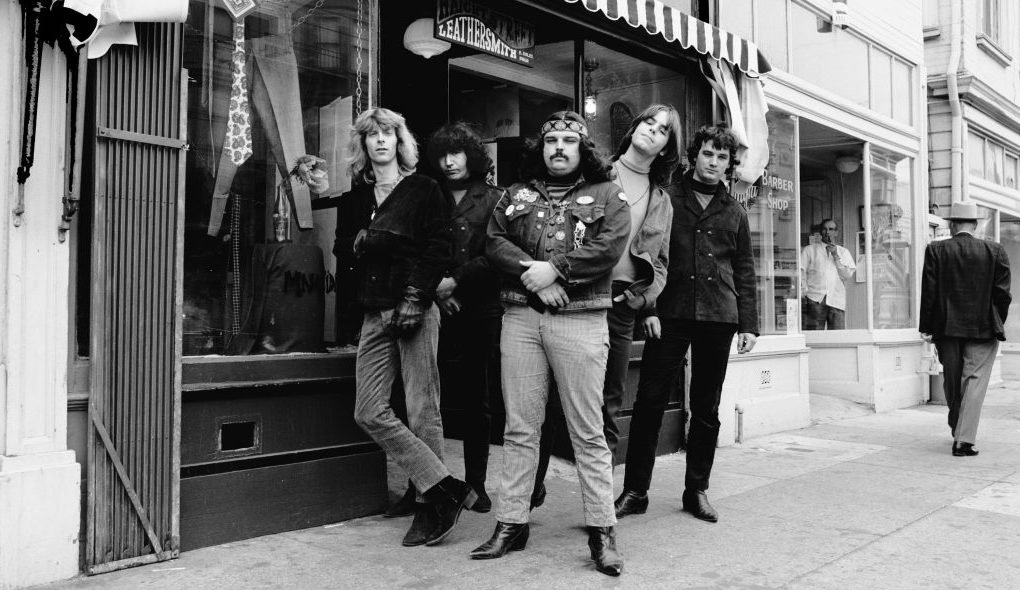
Grateful Dead in the storefront of Peggy's Mnasidika.

When demand for those modified Levi’s outstripped what one seamstress could produce by hand, Caserta famously took the matter to the factory. Her account — told in interviews she gave later and quoted by company historians — describes a visit to a local Levi Strauss location, a sympathetic older employee who remembered Levi Strauss himself, and an initial small run of flared jeans made on credit so the shop could sell an exclusive line for roughly six months. That hand-to-factory bridge is where the story moves from boutique anecdote to industrial replication: Levi’s went on to issue styles like the 646 Bell Bottom in 1969, and corporate histories now trace that model line back to the Haight’s demand for a flare that would fit the new dress code of stage and street.

The social side of the shop — musicians walking in, crews loitering, the sale of posters and the general interchange of tastes — was essential to the diffusion vector that made a local hack into a visible trend. Bands such as Grateful Dead and performers in Jimi Hendrix’s circle were photographed in front of the boutique, and stage visibility from such groups made the silhouette more legible to magazine editors and fashion photographers; those images were then reproduced and circulated. The shop’s function as a hub also included less formal commerce: word-of-mouth introductions, ticket distribution and an atmosphere in which styles were tried on and broadcast from the stage back into the street. The store’s role, therefore, was not only retail but social throughput — a place where fashion, friendship and scene logistics met organically.

The presence of Janis Joplin in that story accelerated visibility. Caserta’s accounts, and multiple profiles that draw on her memoirs and interviews, place Joplin at Mnasidika as a customer and friend at a point when the singer could not always afford new clothes; Caserta has described the exchange in casual terms that underline how small, local gestures fed into larger public moments. “We joked that we met over a pair of Levi’s,” Caserta said in an interview. Caserta’s closeness to Joplin — friendship, love and public association — meant the garments she sold were onstage and backstage at high-profile shows, and that in turn multiplied their visibility beyond Haight Street.
Addiction and later recovery appear as recurring elements in Caserta’s life story, reported by multiple outlets and discussed in her later interviews. Her path includes prison time, arrests in various jurisdictions and, eventually, a turn toward recovery and caregiving: she spent years looking after her mother and later moved away from San Francisco. Those human elements have been foregrounded in obituaries and recollections in a way that treats the Haight era as a complicated human history of risk, care and reinvention rather than a simple heroic chronicle.

The bell-leg silhouette itself did not end with the 1970s; it has recurred in fashion cycles in recent decades and continues to be reworked on runways and in street wear. Company retrospectives and fashion reporting note periodic revivals and reinterpretations, which demonstrates the style’s ongoing commercial plausibility; what began as a Haight street modification now participates in recurrent design cycles that reach a global consumer base.

The bellbottom style resurfaced with distinct shapes in later decades: in the 1990s, rave culture embraced oversized phat pants from brands like JNCO and Kikwear, engineered with wide hems and cargo-scale pockets that suited marathon dance sessions and stood out in strobe-lit spaces. During the early 2000s, the Y2K pop mainstream reintroduced low-rise flares through celebrity wardrobes and music videos, a return amplified by resale markets and fast-fashion copies. In each wave, the cut was altered — from denim bells to rave-ready extremes, then to tailored pop silhouettes — showing how the garment adapted to new demands rather than simply repeating past forms.

Later revivals highlight the style’s versatility within specific subcultures. Psytrance and Goa scenes throughout the 1990s and 2000s retained flared trousers for their functionality at outdoor festivals, while European techno hubs, especially Berlin, often steered in the opposite direction toward dark, narrow fits. By the 2010s and 2020s, high-fashion runways, resale platforms, and celebrity performances revived flares again, producing modernized designs with reinforced hems, stretch fabrics, and adjusted rises to balance practicality with editorial appeal.

    You might also like the article I wrote about "Haight-Ashbury in the 1960s - The Epicenter of the Hippie Movement".

Sources:

  1. https://people.com/janis-joplin-former-lover-peggy-caserta-dead-age-84-8752866
  2. https://en.wikipedia.org/wiki/Peggy_Caserta
  3. https://www.sfheritage.org/heritage-in-the-neighborhoods/haight-street-turns-on/
  4. https://savingplaces.org/places/haight-ashbury
  5. https://www.fugues.com/2020/10/01/the-redemption-of-peggy-caserta/
  6. https://www.levistrauss.com/2019/11/22/how-haight-st-hippie-style-became-a-levis-sensation/
  7. https://www.levi.com/US/en_US/blog/article/the-it-jeans-of-the-1960s
  8. https://www.kqed.org/news/11748384/corner-of-haight-and-ashbury-in-san-francisco-declared-national-treasure
  9. https://howardlovy.com/peggy-caserta/
  10. https://www.sfgate.com/local/article/peggy-caserta-obituary-sf-bell-bottom-jeans-19976707.php
  11. https://www.thetimes.co.uk/article/herb-greene-obituary-photographer-at-the-heart-of-haight-ashbury-q7b3dqq3c
  12. https://www.fitnyc.edu/museum/exhibitions/denim.php
  13. https://scholarworks.iu.edu/journals/index.php/grj/article/view/41711
  14. https://haenfler.sites.grinnell.edu/subcultural-theory-and-theorists/commodification/
  15. https://www.levistrauss.com/2019/08/08/peace-love-bell-bottoms-celebrating-50-years-of-an-iconic-style/
  16. https://www.vulture.com/2018/08/peggy-caserta-janis-joplins-love-comes-clean-for-real.html
  17. https://www.youtube.com/watch?v=yHzA4X3z4lQ
  18. https://www.waudsfuneralhome.com/obituaries/Peggy-Caserta
  19. https://www.wsj.com/style/fashion/peggy-caserta-hippie-fashion-dies-at-84-f3cc9967
  20. https://default.sfplanning.org/Preservation/lgbt_HCS/LGBTQ_HCS_October2015.pdf
  21. https://digitalstories.famsf.org/summer-of-love/
  22. https://www.heddels.com/2019/03/fade-friday-levis-646-50-years-unknown-washes/
  23. https://www.steelzipper.com/steel_zipper_vintage_Levi_646_bell_bottoms.html
  24. https://haightstreetvoice.com/performance-art-comes-to-the-haight/
  25. https://m.facebook.com/SFHeritage/photos/herb-greene-photo-print-of-peggy-caserta-inside-mnasidika-in-1967-located-inside/5045311815546982/
  26. https://savingplaces.org/places/haight-ashbury/updates/launching-a-national-treasure-haight-and-ashbury
  27. https://uregina.scholaris.ca/bitstreams/b5e5a2b9-d4f0-49f3-aa04-9cfd4712c9b5/download
  28. https://medium.com/the-establishment/for-whom-the-bells-toll-the-life-and-politics-of-bell-bottoms-48b6014cd21
  29. https://www.ebar.com/story/58632
  30. https://fashionunited.com/news/fashion/the-bell-bottoms-from-the-runway-to-the-high-street/2021093042469
  31. https://www.vogue.com/article/victoria-beckham-bellbottom-flare-jeans

Thursday, September 11, 2025

Review: Frank Chacksfield - Hawaii (1967)


Rating: 90/100 - Genre: Easy Listening, Orchestral Music, Tiki
Audiophile Production - Phase-4-Stereo

Frank Chacksfield began life as a classically trained pianist and organist in the south of England and moved through radio work and arranging in the 1940s and early 1950s into a career that would make his name synonymous with highly produced orchestral popular records. Born in 1914, he reached commercial peaks in the 1950s and 1960s with easy-listening hits such as Terry’s Theme (Limelight) and Ebb Tide, and by the middle decades of his career his records had sold in very large numbers. Over the years he became associated with a branded string sound brought to record buyers under names like Singing Strings, and his approach favored the studio as a compositional and directing space: he did not simply orchestrate tunes for live presentation but shaped them in the recording room with an arranger’s control and a conductor’s sense for pacing and balance. This professional path — from trained keyboard player through radio-arranger to a studio-first orchestral leader — explains why an album like Hawaii, issued in Decca’s Phase 4 series in the late 1960s, reads less as a field document and more as a carefully staged audio program aimed at home listeners and hi-fi customers.

The album in question was released in the Phase 4 cycle and is most commonly encountered as the UK pressing PFS 4112 and as the US London Phase 4 pressing SP 44087, with publication metadata clustering around late 1966 to January 1967. It was issued in a gatefold presentation that matched Phase 4’s retail strategy: a visually striking jacket to sit beside hi-fi displays, and an audio program designed to show off the record player as much as to entertain. The program itself assembles a chain of Hawaiian and Pacific-flavored standards — items such as Hawaiian War Chant, Now Is The Hour, Red Sails In The Sunset, Song Of The Islands, Tiny Bubbles, Pearly Shells, Hawaiian Wedding Song, Coco-Nut, Blue Hawaii, My Little Grass Shack (In Kealakekua, Hawaii), The Moon of Manakoora and Aloha Oe — and catalog entries show only modest regional sequencing differences between territories, a normal consequence of the label’s international manufacturing arrangements. The choice of these titles places the record squarely inside a mid-century consumer fascination with island themes that gathered commercial force after Hawaii’s admission as a US state in 1959 and the postwar tourist boom that fed popular imagery of the Pacific in Anglo-American markets.

Technically, the album is a product of the Decca Phase 4 method. That method, as explained by engineers and producers who worked on the imprint, relied on multi-group scoring on large multi-channel consoles and a single-pass scoring-and-mix approach meant to produce dramatic stereo movement and clearly identifiable solo moments within a broad orchestral field. In practice that produced wide, deliberate panning, discrete spotlight passages where harp, ukulele figures, or steel-guitar slides are pushed forward and then recessed, and an overall brightness and clarity that were designed to function as playback demonstrations on domestic hi-fi systems. Phase 4 titles were promoted in the trade press and to retail distributors as stereo demonstration records during the promotional cycles of the period, and those marketing choices are audible in how the album is composed: contrast, motion and point-source clarity are part of the music’s grammar as much as melody and harmony.

What listeners hear on Hawaii is therefore an orchestral translation of island material: broad string canvases carry most harmonic weight while recurring coloristic devices — harp arpeggios intended to suggest ocean shimmer, woodwind obbligatos for local color, steel-guitar-like slides and ukulele figures used as punctuation — are brought into relief in short, well-placed episodes. The opening Hawaiian War Chant functions as an immediate attention-getter; the arrangement moves from a percussion-accented intro into sweeping string fanfares and a panning scheme that makes left-to-right motion part of the track’s theatrical argument. Slower songs such as Now Is The Hour and Hawaiian Wedding Song position a lyrical steel-guitar line or an imitation of that instrument above legato strings and occasional harp glissandi, adopting a torch-ballad sensibility that reframes folk or popular lines as orchestral ballads for living-room listening. Where film or stage songs such as Sweet Leilani and theatrical numbers like Bali Ha’i appear, the arranger neutralizes the original phrasing and reshapes dynamics and color to sustain a side-long atmospheric flow rather than to deliver show-stopping stage moments; the result is a series of mood pieces that privilege continuity and listening comfort.

Repeated harp figures imply shimmering water without returning to literal imitation; woodwinds provide short obbligatos rather than extended solos; small-group interjections — a ukulele pattern here, a muted steel-guitar lick there — punctuate the string core without displacing it. Harmonically the arrangements preserve the original tunes’ diatonic anchors while adding extended chords, gentle chromatic passing harmonies and smooth voice-leading so that the progressions read as lush orchestral pads under a clear top-line melody rather than as radical reharmonizations. In short, the set places melodic clarity and singability at the center and uses studio techniques to orient the listener within a stereo sound image.

Those choices also mark a clear difference between this record and the percussion- and found-object-centric exotica that figures in US lounge scenes of the 1950s and 1960s. Martin Denny and Arthur Lyman, for example, built albums that foreground exotic percussion, reverberant gong hits and unusual timbres as primary scene-setting devices. Chacksfield’s record, by contrast, adopts the surface motifs of the Tiki/exotica trend — song titles, occasional ukulele and steel touches — but relocates them into a polished orchestral idiom in which strings, not percussion, govern the listener’s attention. That approach renders the album a lounge-orchestral reading of island material rather than an attempt at documentary field recording.

The archival trace that supports precise personnel identifications for Phase 4 sessions is thin. Public sleeve documentation for this title does not reliably list full session rosters, and that matches a broader practice on the imprint: London studios commonly used contracted top-tier session players whose names were infrequently printed on consumer sleeves; production authorship and the label’s sonic brand were foregrounded. For researchers who want forensic detail about who played a given steel-guitar lick or where a harp was miked, the most reliable sources are scanned copies of the original pressing’s inner sleeve or Decca’s session logs. Those artifacts are spotty in public web archives and are therefore the usual bottleneck when trying to move from listening-based description to named personnel and notated scores.

    You might also like the reviews I wrote for:

Sources:

  1. https://www.absoluterecords.com.sg/release/1215248/frank-chacksfield-and-his-orchestra-hawaii
  2. https://www.worldradiohistory.com/Archive-All-Music/Billboard/60s/1967/Billboard%201967-01-28.pdf
  3. https://bernardherrmann.org/articles/interview-damato/index.html
  4. https://www.exotictikiisland.com/2025/01/16/frank-chacksfield-and-his-orchestra-hawaii/
  5. https://www.worldradiohistory.com/Archive-All-Music/Record-World/60s/67/RW-1967-09-23.pdf
  6. https://www.starborne.net/music-directors/frank-chacksfield/
  7. https://finnley.audio/2025/08/04/frank-chacksfields-hawaii-a-phase-4-stereo-journey-to-paradise/
  8. https://instrumentalsforever.eu/artists/frank-chacksfield-1914-1995/
  9. https://www.youtube.com/playlist?list=PLuhAEE12s8eOUvbQxAaD_hnBSYui-afzP
  10. https://www.allmusic.com/artist/frank-chacksfield-mn0000043647
  11. https://www.45cat.com/vinyl/album/sp44087us
  12. https://open.spotify.com/album/527LHkqZNyLl14Uor9cEEl
  13. https://music.apple.com/dk/album/hawaii/1707237876
  14. https://www.spaceagepopmusic.com/hawaiian-music/hawaii-frank-chacksfield-and-his-orchestra.php
  15. https://musicbrainz.org/series/d6791c5c-375c-4573-b5ed-df08c54b8656
  16. https://trackingangle.com/features/the-wonderful-world-of-decca-phase-4-stereo-part-1-bond-and-beyond-with-roland-shaw-and-is-orchestra
  17. https://www.theabsolutesound.com/articles/the-decca-phase-4-stereo-concert-series/
  18. https://www.discogs.com/release/4853149-Frank-Chacksfield-And-His-Orchestra-Hawaii
  19. https://en.wikipedia.org/wiki/Frank_Chacksfield
  20. https://coverheaven.co.uk/frank-chacksfield-and-his-orchestra-hawaii/
  21. https://www.ebay.com/itm/388410023125
  22. https://www.ebay.com/itm/405913720665
  23. https://vinylheaven.com/catalog/product/hawaii-1706747
  24. https://www.recordcity.jp/catalog/314943
  25. https://en.wikipedia.org/wiki/Phase_4_Stereo
  26. https://www.prestomusic.com/classical/products/8188670--phase-4-stereo
  27. https://www.theatlantic.com/business/archive/2018/06/a-new-golden-age-for-the-tiki-bar/562025/
  28. https://en.wikipedia.org/wiki/Tiki_culture
  29. https://www.spaceagepop.com/whatis.htm
  30. https://s.music.org/49/item/9247-the-other-world-music-percussion-as-purveyor-of-cultural-cues-in-exotic-lounge-music.html
  31. https://en.wikipedia.org/wiki/Arthur_Lyman
  32. https://www.smithsonianmag.com/smithsonian-institution/theres-more-to-classic-tiki-than-just-kitsch-180964473/

Tuesday, September 2, 2025

Psychedelic Jukebox: [1967] The Freak Scene - My Rainbow Life


The Freak Scene began in the mid-1960s not as a conventional band whose members toured under a fixed roster but as a deliberate studio project helmed by Rusty Evans (born Marcus Uzilevsky). In the spring of 1967 Evans oversaw the Columbia release Psychedelic Psoul, a record that placed Middle Eastern melodic gestures and modal motifs at the center of its arrangements and that presented the material as a crafted studio statement. The project’s provenance and its label placement on Columbia make clear that this was one of the company’s early titled moves into the then-fashionable psychedelic market, yet the record itself failed to find chart success and sank from mainstream view as the year closed.

Within that context My Rainbow Life emerges as a revealing case study of how a song could take two concurrent paths in the same metropolitan scene. On the Columbia LP the track appears as a concise piece of raga-tinged pop, where its modal lead line, droning harmonic underpinning and liberal use of reverb place it alongside other East-leaning album moments such as A Million Grains of Sand and Rose of Smiling Faces. That LP realization favors an effect-rich approach: the lead figure floats above a stabilized sonority created by layered studio techniques, and the lyric deploys color-filled visual images as the primary expressive device rather than depending on verse/chorus convention. The Columbia presentation thus reads as a polished studio interpretation of a piece that had simultaneous life elsewhere in New York’s single-driven garage economy.

The lyrical content of My Rainbow Life can be understood as exploring a state of perceptual expansion, reflecting the mid-1960s fascination with consciousness and heightened awareness without depicting literal events. Words are carefully chosen to maintain a balance between accessible pop phrasing and the aesthetic experimentation Evans and his collaborators sought: references to “flowing colors,” “shifting lights,” and “the world anew” recur, producing a cohesive image that threads through both the Columbia LP and the Third Bardo single versions.

Running in parallel to the Freak Scene LP was a circulation of the composition under a different banner: the New York group Third Bardo placed Rainbow Life on the B-side of their single “I’m Five Years Ahead of My Time” on Roulette (catalog R-4742) in 1967, a pressing that preserves a more urgent, guitar-forward reading of the tune. The Bardo flip is credited on label and in standard discographies to R. Evans and Victoria Pike and is associated in the single’s production paperwork with Teddy Randazzo’s arranging and producing activities, which ties the piece directly into Randazzo’s studio orbit and into the Pike–Randazzo household of writers. The Third Bardo pressing delivers a rawer energy—an up-front rhythm guitar and taut vocal delivery—where the Eastern scalar contour remains prominent but is presented with a garage edge rather than the smoother, studio-layered sheen of the Columbia cut.

The relationship between those two contemporaneous recordings is neither accidental nor coincidental: Evans carried a thread of ideas across sessions, and the same Manhattan studio matrix that produced the Third Bardo acetate runs and the Freak Scene album sessions explains why similar modal gestures and timbral choices recur in both versions. Sessions associated with Bell Sound and Bell Studios appear in the paper trail and in later recollections, and surviving acetates and reissue transfers point to Bell-sourced material surfacing in compilation series; these workshop conditions allowed Evans to treat instrumentation as an adjustable palette, substituting sitar-like guitar timbres, sustained drones and tape treatments for authentic Eastern instruments while keeping the melodic contours tied to Indian-derived modal shapes. In interviews Evans has emphasized that he conceived and directed the Freak Scene sessions and that his earlier experiments—most notably the work cut under The Deep name—functioned as a testing ground for the approaches later deployed on the Freak Scene LP.

   You might also like following song from the Psychedelic Jukebox: "[1967] Bill Plummer & Cosmic Brotherhood - Journey to the East".

Sources:

  1. https://www.discogs.com/release/9975681-The-Freak-Scene-Psychedelic-Psoul
  2. https://www.shazam.com/song/1470493779/rainbow-life
  3. https://www.discogs.com/release/29645887-The-Third-Bardo-Im-Five-Years-Ahead-Of-My-Time-Rainbow-Life
  4. https://www.45cat.com/record/r4742us
  5. https://www.discogs.com/master/225454-The-Freak-Scene-Psychedelic-Psoul
  6. https://en.wikipedia.org/wiki/Psychedelic_Psoul
  7. https://midheaven.com/item/freak-scene/psychedelic-psoul-by-freak-scene-cd
  8. https://lionproductions.org/pages/FREAKSCENE.html
  9. https://www.psychedelicbabymag.com/2011/09/rusty-evans-interview-about-deep-freak_25.html
  10. https://www.sputnikmusic.com/review/54169/The-Freak-Scene-Psychedelic-Psoul/
  11. https://en.wikipedia.org/wiki/Raga_rock
  12. https://tyme-machine.blogspot.com/2009/05/third-bardo-lose-your-mind-us-1967-ep.html
  13. https://www.discogs.com/release/1696018-Various-Psychedelic-Microdots-3-My-Rainbow-Life
  14. https://www.discogs.com/release/6318278-The-Freak-Scene-The-Devils-Anvil-Psychedelic-Psoul-Hard-Rock-From-The-Middle-East
  15. https://p-vine.jp/artists/the-freak-scene
  16. https://www.discogs.com/release/2649021-The-Freak-Scene-Psychedelic-Psoul
  17. https://open.spotify.com/track/21CmA9auZceWhW2Ijtjk2T
  18. https://music.apple.com/us/artist/the-freak-scene/431665949
  19. https://www.popsike.com/THE-THIRD-BARDO-Rainbow-Life-Im-Five-Years-Ahead-of-My-Time-45-Roulette-R4742/350786823826.html
  20. https://www.youtube.com/watch?v=P_J8g4qgh-o
  21. https://www.whosampled.com/sample/68300/Kid-Cudi-GHOST%21-The-Freak-Scene-My-Rainbow-Life/
  22. https://en.wikipedia.org/wiki/Man_on_the_Moon_II%3A_The_Legend_of_Mr._Rager
  23. https://psychedelicized.com/playlist/f/the-freak-scene/
  24. https://www.allmusic.com/artist/the-freak-scene-mn0000069506
  25. https://www.soulfulkindamusic.net/roulette.htm
  26. https://cosmicmindatplay.wordpress.com/2014/04/30/classic-singles-97-the-third-bardo-im-five-years-ahead-of-my-time-rainbow-life-1967/
  27. https://www.chaputa.com/store/third-bardo-my-rainbow-life-im-five-years-ahead-of-my-time-7/
  28. https://www.opaquedynamo.com/product/the-third-bardo-im-five-years-ahead-of-my-time-rainbow-life-7-vinyl/
  29. https://psychedelic-rocknroll.blogspot.com/2009/04/the-third-bardo-im-five-years-ahead-of.html
  30. https://www.allmusic.com/album/psychedelic-psoul-mw0000841405
  31. https://therisingstorm.net/the-freak-scene-psychedelic-psoul/
  32. https://www.scribd.com/doc/138177660/The-Acid-Archives
  33. https://www.allmusic.com/album/psychedelic-psoul-hard-rock-from-the-middle-east-mw0000041005
  34. https://en.wikipedia.org/wiki/The_Deep_%28band%29

Monday, September 1, 2025

Review: Various Artists - Neurotic Reactions 2: 16 Obscure Mod Smashers, 1965-1970 (2011)


Rating: 90/100 - Genre: Northern Soul, Mod, Garage-Psych. 

Neurotic Reactions Vol. 2: 16 Obscure Mod Smashers, 1965–1970 was issued in 2011 on the small Spanish imprint Crazy Apple Boutique (listed as CRAP1050LP), a purpose-made pressing aimed at collectors and crate-diggers. The set, assembled under the aesthetic hand of Eze (credited in collector circles as Eze DJ), presents itself as a follow-up within the Neurotic Reactions series and reads as a concentrated dossier of short, high-energy 45s and EP tracks selected for immediate dancefloor utility and collector interest.

From the first grooves it is clear that the compilers were after variety inside a tightly focused program: the records come from the UK, the United States, Spain, France, Mexico, Sweden, the Netherlands, Germany and Australia and cover mod-aligned soul, garage, freak-beat and continental Ye-Ye variants, each cut trimmed to spare running times that favor hooks, riffs and percussive drive. The set was professionally remastered and include promise of substantial liner notes for each artist.

Physical distribution for the pressing was directed largely at niche markets: import listings show the title appearing with European specialist shops and Japanese outlets rather than mainstream chains, and that pattern helps explain why the initial pressings circulated principally through collector channels and import dealers. That commercial positioning is echoed in the compilation’s sequence and editorial choices: the selection privileges concise two- to three-minute forms, quick hooks and rhythmic clarity so that a DJ or radio programmer can slot each cut directly into a set without losing momentum. The sequencing itself is pragmatic; stomps and fuzz-driven items are interleaved with groove-oriented soul pieces to sustain pace.

The musical breadth of the LP becomes apparent when the listener moves past the opener: Barry Window arrives with End of Our Road, a compact pop/soul nugget whose short form and hook-first construction have allowed it to reappear in other compilations. Combinations supply Bump Ball, a rhythm-forward number whose propulsion marks it as a straightforward dance cut culled from US 45 archives, while Jack Treese’s Je suis un éléphant lands as a French-language Ye-Ye oddity with a playful, slightly psychedelic guise rather than a straight soul outing. Virgil Murray’s Tomorrow’s Yesterday contributes I Still Care, a horn-tinged blue-eyed-soul piece with a small-club combustion that reads as one of the set’s authentic soul inflections. The Goodies offer Such a Good Time, an Australian 1966 single that leans melodic and Beatles-tinged in its phrasing, and Los Tiburones present Me Has Cazado, a Spanish renditional take on the raw power-chord groove familiar from the Kinks which is traceable in Spanish 45 discographies and earlier EP issues. In the roster the gritty, R&B-weighted The Sting RaysI’m Gonna Surprise You stands as a rawer garage cut, while Sweden’s Celest delivers Sweet Wine, a melodic B-side with a soft psychedelic afterglow.

Across the flip the compilation preserves the small-label provenance that defines its appeal: Don & Jerry with The FugitivesIn the Cover of Night originates from a mid-1965 Fabor single and typifies the loose, economy-minded attack of regional US garage 45s rescued by compilers; Norma’s Quiero Amor appears in Polydor Mexico EP listings from the late 1960s and shows how Latin-American acts adapted freak-beat and Mod sensibilities for Spanish-language audiences; The MeaslesBye Birdie Fly is a clipped UK beat single with punchy phrasing; the Dutch Sparklings add fuzz-dominated energy with Seven Jump; The Dave Peace Union’s Seventh Son is one of the later entries with a 1970 dating that leans toward a late-period mod stomp; The Peddlers bring a more polished organ-anchored mod-soul moment in Delicious Lady, where the documented interplay between Roy Phillips’ voice and organ work gives the track a measured groove among otherwise rawer cuts; Katty Line supplies a French-language semi-psychedelic Ye-Ye entry in Un petit peu d’amour and John O’Brien Docker’s Get Wise, Girl functions as the German contribution, surviving in collector circles and sometimes linked to soundtrack material, which accounts for its slightly theatrical delivery.

Most tracks favor a central riff or call-and-response chorus, compressed arrangements and tight instrumental punches so that they work as smashers in a DJ set. This is not an academic restoration project that foregrounds exhaustive session files; it is a pragmatic rescue operation that reissues danceable regional rarities for enthusiasts who want short, high-impact moments. The presence of better-known UK mod-soul material such as The Peddlers alongside unheralded continental and Latin American rarities demonstrates a conscious balance—placing a polished organ groove next to a fuzz-driven Spanish take on a Kinks riff amplifies contrasts and shows how local scenes adapted Anglo-American templates into floor-ready regional forms.

  You might also the the article I wrote about "Subculture UK: The First Wave of Mods in the Sixties".

Sources:

  1. https://www.uomoragnoclub.it/english.php
  2. https://sweetgroovesrecords.com/producto/vv-aa-neurotic-reactions-vol-2/
  3. https://diskunion.net/rock/ct/list/0/0/22685
  4. https://www.ipunkrock.com/node/123200
  5. https://www.45cat.com/artist/los-tiburones
  6. https://www.classical33.co.uk/product/special-baf-sounds-volume-1-vinyl-lp-lp-record-compilation/
  7. https://www.youtube.com/watch?v=hft85PEwo6c
  8. https://www.45cat.com/label/polydor-mx
  9. https://www.45cat.com/record/uh9870
  10. https://en.todocoleccion.net/vinyl-records/single-7-45-rpm-the-sparklings-seven-jump-now-its-your-turn-to-cry-1967-nd-garage-psych~x441953782
  11. https://open.spotify.com/album/0qejvF0xwkC9z1JgmwMDDb
  12. https://www.ebay.com/itm/224139996642
  13. https://www.youtube.com/watch?v=LHJYRjlNH9w
  14. https://www.ebay.com/itm/265034192315
  15. https://groups.io/g/groupemusicalgroup/topics
  16. https://www.discogs.com/release/3078550-Various-Neurotic-Reactions-2-16-Obscure-Mod-Smashers-1965-1970
  17. https://towerrecords.com/products/neurotic-reactions-2-neurotic-reactions-2
  18. https://www.discogs.com/release/5446649-Barry-Window-I-Thank-You
  19. https://music.apple.com/us/artist/barry-window/445783809
  20. https://www.discogs.com/release/2939342-The-Combinations-Bump-Ball-Im-On-The-Outside-Looking-In
  21. https://www.youtube.com/watch?v=evC12YwyuD0
  22. https://www.discogs.com/release/5562631-Jack-Treese-Je-Suis-Un-Elephant
  23. https://www.youtube.com/watch?v=DYlJs8PSekc
  24. https://www.marmosetmusic.com/browse/69703-i-still-care
  25. https://www.discogs.com/release/1759076-Virgil-Murrays-Tomorrows-Yesterday-I-Still-Care-Summer-Dreamin
  26. https://www.discogs.com/release/5596577-The-Goodies-Such-A-Good-Time
  27. https://www.discogs.com/release/5027413-Tiburones-Me-Siento-Feliz-Do-Wah-Diddy-Diddy-Linda-Chica-Me-Has-Cazado
  28. https://en.todocoleccion.net/vinyl-records/los-tiburones-7ep-me-siento-feliz-3-temas-1965-buena-condicion-raro~x201475128
  29. https://www.youtube.com/watch?v=f5u6LfMDvOM
  30. https://www.popsike.com/php/quicksearch.php
  31. https://www.45cat.com/record/xh5003
  32. https://www.discogs.com/release/11157673-Celest-Black-And-Red-Sweet-Wine
  33. https://www.discogs.com/release/7345492-Don-Jerry-With-The-Fugitives-In-The-Cover-Of-Night-I-Cant-Quit
  34. https://www.supershop.sk/
  35. https://www.discogs.com/release/4456040-The-Measles-Casting-My-SpellBye-Birdie-Fly
  36. https://www.45cat.com/record/db7531
  37. https://www.discogs.com/release/11378790-The-Sparklings-Seven-Jump
  38. https://www.discogs.com/release/3529851-Dave-Peace-Union-Blues-And-Beat
  39. https://www.discogs.com/release/11379944-The-Peddlers-Whatll-I-Do-Delicious-Lady
  40. https://open.spotify.com/track/6sdezFWXswTGEHQmvavwl9
  41. https://www.youtube.com/watch?v=8wUvWHFUXVc
  42. https://secondhandsongs.com/performance/1592784/all
  43. https://www.discogs.com/release/15561114-John-OBrien-Docker-Get-Wise-Girl
  44. https://www.youtube.com/watch?v=DwO7kf_pAXg
  45. https://www.discogs.com/release/2188370-Various-Neurotic-Reactions-20-Worldwide-Mod-Psych-Freak-Rock-Smashers
  46. https://kendrasteinereditions.wordpress.com/2012/01/24/neurotic-reactions-2-crazy-apple-boutique-lp-spain/
  47. https://wfmu.org/playlists/shows/43663
  48. https://www.wfmu.org/playlists/shows/43739

Sunday, August 31, 2025

Review: Django Reinhardt & Stéphane Grappelli - A Swinging Affair (recorded 1937-39, released 1980)


Rating:  90/100 - Gypsy Jazz/Jazz Manouche, Swing.

Django Reinhardt and Stéphane Grappelli appear on the sleeve of the 1980 Decca issue with a title that promises swing, but the record is less a new meeting than a carefully assembled historical window into their earlier studio work. Issued in Germany (Decca catalog 6.24725 AO) and presented in monaural transfers, A Swinging Affair was produced for the buyer who wanted a compact survey of the Quintette’s recorded voice: it gathers sides between 1937 and 1939. It's packaged by a team that credited Artifex Studio for the artwork, listed Colin Brown as producer and acknowledged remastering by John Wadley. From the first grooves the compilation signals its curatorial intent by juxtaposing American standards such as Stardust, Body and Soul, If I Had You and Tea for Two with Quintette originals and brisk instrumentals like Swingin’ with Django, Hungaria and Henderson Stomp, so the listener hears both the repertoire of Broadway and Tin Pan Alley and the pieces that crystallized the group’s own approach. Because the transfers are drawn from pre-1956 masters and presented in mono, the record privileges a focused center image in which violin and guitar trade phrases with unusual clarity; that presentation choice in turn lets the acoustic percussive elements—the rhythm-guitar attack and the bass quarter-notes—register with an immediacy that stereo reprocessings sometimes soften.

The story of how that sound came into being begins in Paris in the early 1930s, when Quintette du Hot Club de France coalesced around two very different but perfectly complementary improvisers. Reinhardt arrived from a Manouche Romani milieu on the outskirts of Paris and developed a guitar voice that combined continental dance gestures, traces of Balkan inflection and the American swing pulse then filtering into European dance halls. A severe fire in his youth left him with functional use of two fingers on his left hand, and the way he adapted—favoring horn-like single-line phrasing, inventive chord voicings centered on index and middle-finger shapes, and rapid, incisive right-hand articulation—reorganized the role of the guitar from accompanist to frontline solo instrument. Grappelli brought a very different but complementary background: raised amid French dance orchestras and theater ensembles, he entered jazz with a melodic sensibility that privileged long singing lines, flexible time and a chamberlike ease; these qualities made him especially fit to state themes and supply counter-melodies that felt like continuations of a song’s phrase. When they first met informally in the early 1930s and then organized their work more formally in 1934—sessions that began in venues such as the Hotel Claridge and led to Ultraphone recordings that September—the combination produced a small-group sound that dispensed with percussion and piano and relied instead on a string-only lineup of violin, lead guitar, two rhythm guitars and bass.

That choice of instrumentation was not an absence for its own sake but a deliberate acoustic design: the rhythm guitars executed the percussive la pompe groove, supplying drive and pocket while leaving open the tonal space for the violin and lead guitar to converse in sharp, unmasked detail. The Ultraphone sides of 1934 established the rhetorical devices listeners still recognize in the compilation era: compact ensemble riffs, bright unison tags, and a balance between arrangements that read like written passages and improvisations that retain a sense of spontaneity. In performance the division of labor is often consistent: Grappelli will present the song’s theme with sustained bowing and a clear vocal-like arc, and Reinhardt will answer in filigree, compressing blues gestures and chromatic enclosures into short choruses that both outline the harmony and increase rhythmic tension. On instrumentals such as Swingin’ with Django the la pompe becomes a springboard for concise, highly wrought guitar choruses; on pieces named Hungaria or Henderson Stomp the minor-mode drama and rhythmic displacement in Reinhardt’s figures meet Grappelli’s capacity to make even the briskest tempos sing, so the interplay reads as fiery and light at once.

The absence of drums is central to how those details register. Without cymbal wash or backbeat accents, the up-strokes of rhythm guitar and the bass’s placement take on enlarged perceptual importance: micro-timing shifts and small accent choices become audible levers for swing and propulsion. That a mono compilation can preserve this effect, and sometimes do so with less phase smear than stereo remastering, is part of why labels in 1980 and the surrounding years turned to such packages as a way of reintroducing pre-war sources to new audiences. A Swinging Affair sits squarely within that wave of reissues: it is archival in intent, collecting material from the Quintette’s golden years and from a few reunion dates, and its sequencing deliberately alternates ballad readings of the American songbook with taut dance originals so listeners can hear how the same frontline voices negotiate different harmonic canvases and tempos.

Biographically, the chapters of the two protagonists’ careers explain why the recordings have held their appeal. Reinhardt’s technical adaptations—his narrow, horn-like single lines, his chordal vocabulary built around limited left-hand fingering—produce solos that feel economical and forward-leaning; they suggest an improviser who could compress chromatic enclosures and surprising voice-leadings into memorable statements. Grappelli acted as the tonal and lyrical binder, shaping cadences and reconstructing chorus endings so that a solo always resolved into a singing phrase rather than an exhibition of technique alone. Their pre-war studio period was meteoric; World War II dispersed them—Grappelli remained in England while Reinhardt returned to Paris—and the wartime hiatus produced separate careers that were equally productive in different ways. After the war they reunited at times, notably in Rome in 1949, and those sessions document that their telepathy remained intact even as jazz language around them had moved along other lines. Reinhardt’s brief but influential contacts with visiting American figures and his 1946 association with Duke Ellington underline how his European innovations registered overseas. Ellington’s remark that Reinhardt was "the most creative jazz musician outside the USA" has been cited in concert program notes and retrospective commentaries (Duke Ellington; cited in Elbphilharmonie program material).

Grappelli’s later career reinforced the pair’s broader public presence: he welcomed cross-style partnerships, reintegrated string ensembles, and even entered dialogues with classical figures—his recorded encounters with Yehudi Menuhin in the 1970s being a prominent example—thereby broadening the audience for violin jazz while preserving the lyricism that had marked his earliest work. Collectively, the two biographies illuminate their combination on record: Reinhardt’s harmonic nerve and rhythmic insistence matched Grappelli’s flowing, songlike phrasing so that the duo’s lines often sounded like parts of a single singing instrument rather than competing solos.

When the music itself is considered in harmonic and rhythmic terms, certain features recur. Reinhardt’s solos habitually compress chromatic approaches and diminished-form gestures into short statements that point the harmony forward; Grappelli’s responses frequently rephrase cadences so a chorus finishes like a sung line. On originals such as Swingin’ with Django the guitar’s compressed bluesy bursts and the violin’s airy paraphrase create a contrast with standard readings of If I Had You or Tea for Two, where the violin often carries the main melody and the guitar elaborates the inner harmony. 

  You might also like following Jazz Reviews:

Sources:

  1. https://music.metason.net/artistinfo?name=Django+Reinhardt
  2. https://syncopatedtimes.com/history-and-rebirth-of-the-quintette-du-hot-club-de-france/
  3. https://www.allmusic.com/artist/django-reinhardt-mn0000136220
  4. https://www.britannica.com/biography/Django-Reinhardt
  5. https://syncopatedtimes.com/profiles-in-jazz-django-reinhardt/
  6. https://www.allmusic.com/artist/stephane-grappelli-mn0000749504
  7. https://musicenthusiast.net/2017/06/03/quintette-du-hot-club-de-france/
  8. https://music.si.edu/story/jazz
  9. https://www.kagoshimarecords.com/release/8953915/stephane-grappelli-django-reinhardt-a-swinging-affair
  10. https://www.mosaicrecords.com/the-great-jazz-artists/django-reinhardt/
  11. https://kids.britannica.com/students/article/St%C3%A9phane-Grappelli/311494
  12. https://www.theguardian.com/music/2016/jun/17/yehudi-menuhin-stephane-grappelli-interview-classical-jazz-1972
  13. https://gypsyjazzuk.wordpress.com/gypsy-jazz-uk-home/djangos-birth-and-early-childhood/quintette-du-hot-club-de-france/
  14. https://www.djangoreinhardt.info/printdiscography.php

Saturday, August 30, 2025

Psychedelic Jukebox: [1967] The Elopers - Music To Smoke Bananas By


The Elopers released a single in the autumn of 1967 that has since been treated by collectors and regional compilers as a compact curiosity and a telling example of a local American psychedelic instrumental: the 7" Music To Smoke Bananas By with its B-side Peak Beat appeared on the tiny RLW imprint under the catalogue/run number KCMS 1286, recorded in Colorado. The record credits the A-side to Randy Weatherington and Jay Ridge Jr., names that recur across later reissue tracklists and CD compilations that made the piece available to new listeners decades later.

The band is tied to the Colorado scene, and regional archivists and compilers place the origin point for the record in Manitou Springs and the surrounding Colorado Springs area, which is consistent with other tiny local imprints of the mid-1960s that documented high-school and college-age players issuing one or two singles for local distribution. The A-side is a short, focused instrumental of roughly two minutes, built on a steady low-end anchor and a repeating rhythmic motif under a fuzz-heavy lead guitar line with abundant reverb; the arrangement favors concision and an immediate hook rather than extended soloing.

The title Music To Smoke Bananas By maps directly onto a broader cultural moment in 1967 when a widespread hoax about smoking banana peels — often called “bananadine” in underground press accounts — circulated in student newspapers and the countercultural press. That story, which the mainstream press later covered and which figures in oral recollections of the era, fed a swath of ephemeral jokes, “how-to” articles and stage gag material in which musicians and audiences sometimes played along; the Elopers’ title sits squarely within that bout of psychedelic humor and rumor rather than implying any serious instruction. Reexaminations of the hoax, plus period magazine pieces, place the origin of the claim in the underground press in early 1967 and track how it spread through the summer of that year. 

 You might also like another song from the Psychedelic Jukebox: "[1967] The Peanut Butter Conspiracy - Light Bulb Blues".

Sources:

  1. https://kimsloans.wordpress.com/colorado-garage-e-thru-i-bands/
  2. https://www.groovespin.pl/album/various-psychedelic-states-colorado-in-the-60s-1722476
  3. https://www.45cat.com/record/kcms1286
  4. https://www.youtube.com/watch?v=lD_hKZuK_tQ
  5. https://www.gramodesky.cz/album/various-psychedelic-states-colorado-in-the-60s-1722476
  6. https://time.com/archive/6890220/youth-tripping-on-banana-peels/
  7. https://doubleblindmag.com/smoking-banana-peels-hoax/
  8. https://commonplacefacts.com/2024/06/13/the-great-banana-peel-smoking-hoax/
  9. https://gripsweat.com/item/385584549200/elopers-music-to-smoke-bananas-by-peak-beat-us7-67-rlw-productions-kcms-1286
  10. https://www.lvthns.com/elopers-music-to-smoke-bananas-by-peak-beat-u-s-7-67-rlw-productions-kcms-1286-RE9CG1RCQVxXQR5T
  11. https://www.groovespin.sk/album/various-psychedelic-states-colorado-in-the-60s-1722476
  12. https://psychedelicstates.bandcamp.com/album/psychedelic-states-60s-colorado-vol-2
  13. https://urbanaspirines.blogspot.com/2025/02/various-psychedelic-states-in-60s-part.html
  14. https://www.amazon.com/Psychedelic-States-Colorado-VARIOUS-ARTISTS/dp/B000NQPSQM
  15. https://paradiseofgaragecomps.blogspot.com/2014/01/
  16. https://www.roarrecs.com/products/various-highs-in-the-mid-sixties-volume-18-colorado-lp-comp-unofficial-1
  17. https://www.ebay.com/itm/296565444166
  18. https://loadsamusicsarchives.blogspot.com/2019/05/psychedelic-singles-98-cds.html
  19. https://nyujournalismprojects.org/eastvillageother/recollections/bananas
  20. https://www.discogs.com/release/7014101-The-Elopers-Music-To-Smoke-Bananas-By
  21. https://www.discogs.com/artist/1344796-The-Elopers
  22. https://www.discogs.com/master/653546-Various-The-Psychedelic-Experience-Vol-2
  23. https://www.discogs.com/release/2189395-Various-The-Psychedelic-Experience-Vol-2
  24. https://daily.jstor.org/smoking-banana-peels-to-get-high-was-briefly-a-thing/
  25. https://www.atlasobscura.com/articles/smoking-banana-peels-1960s-donovan-mellow-yellow-hoax
  26. https://gripsweat.com/item/121390469284/elopers-rlw-1287-music-to-smoke-bananas-bypeak-beat-rare-fuzz-psych
  27. https://www.discogs.com/user/Loungistics_vinyl
  28. https://www.discogs.com/master/1590934-Various-Highs-In-The-Mid-Sixties-Volume-18-Colorado

Friday, August 29, 2025

Review: Eddie Cochran - The Very Best of Eddie Cochran: Tenth Anniversary Album (recorded 1956 - 1960, released 1970)


 Rating: 80/100 - Genre: Rockabilly.

Born in Minnesota and raised largely in Bell Gardens, California, Eddie Cochran soaked up country picking, rhythm and blues, and the bustling amateur scene of post-war Los Angeles. He paired briefly with Hank Cochran (no relation) as the Cochran Brothers before shifting to a leaner, guitar-forward sound under the guidance of Jerry Capehart, who recognized that Eddie’s strengths—tight rhythm work, quick-wit arranging, a radio-ready voice—could flourish on Liberty sessions. Contemporary overviews by reputable institutions summarize his rapid rise from Crest/Ekko singles to Liberty hits, his standing as a writer who handled his own sessions, and his lasting regard among British players who heard these discs as a toolkit rather than relics.

Inside the studio, Cochran behaved like a hands-on arranger. Accounts from the Summertime Blues date at Gold Star Studios describe him stacking parts, coaching background voices, and working with Larry Levine to make modest resources sound bigger than the room. “We were doing a lot of overdubbing… we put a board on the floor and stomped and clapped,” Levine recalled, a neat window onto Cochran’s make-it-work method: few instruments, well-timed accents, and smart use of echo. The same method animates C’mon Everybody and Somethin’ Else, where a limited set of tools—snare crack, slapped acoustic, short electric bursts—does the job better than any piling-on could.

The guitar at the heart of these sessions has become almost a character of its own. Cochran favored a modified Gretsch 6120—bright, percussive, and easy to coax into tidy bends—which decades later would be honored with a signature model. 

Even beyond his own hits, the songs traveled. The tale of a Liverpool teenager impressing a skiffle band leader with Twenty Flight Rock is well documented—Paul McCartney’s memory of that day has been consistent for years, and it tells you how adaptable Cochran’s parts were to a small-group setup with one electric guitar, one acoustic, and a simple kit. “I did ‘Twenty Flight Rock’… That’s what got me into The Beatles,” McCartney said; what matters is the ease with which another musician could pick up the riff and make it work in a new context.

Taken together, the album’s sixteen tracks sketch a studio thinker who wrote for performance and for tape at the same time. The arrangements prize clarity; the playing focuses on punch and swing; the writing keeps verses brisk and hooks unavoidable. When Jerry Capehart says the Summertime Blues idea clicked in under an hour, it doesn’t reduce the achievement—it explains it. Cochran knew how to put the right sounds in the right places and stop when the song was complete

Eddie Cochran occupies the foreground of a careful commercial and archival effort that resulted in the 1970 UK compilation The Very Best of Eddie Cochran — Tenth Anniversary Album, a single-disc Liberty Records issue released with the catalogue number LBS 83337 and presented as a fully laminated 16-track LP aimed at reconnecting a new record-buying public with selections from the late 1950s singles. The package combined the most familiar titles from Cochran’s catalogue with a handful of covers and instrumentals so that listeners would find both the hits that had lingered in the public ear and the other sides that show how his records were put together; the running order included well-known singles such as Summertime Blues, C’mon Everybody, Somethin’ Else and Three Steps to Heaven alongside recorded takes of songs like Blue Suede Shoes and Hallelujah, I Love Her So. The record was marketed in Britain and in parts of continental Europe in the spring of 1970, and some territories saw variant packages — notably a gatefold issue released in France. The commemorative wording that gave the album its publisher-friendly title referred to the tenth anniversary of Cochran’s passing in 1960, and the release should be read both as a commercial compilation and as a curated snapshot of single-era material.

The album’s appearance in the charts underlines the continuing public interest in those sides: the compilation entered the Official UK Albums Chart in 1970 and peaked at number 34, a concrete sign that a decade after the original singles circulated there was an active market for a compact, accessible selection. Liberty/United Artists catalogue managers in the UK oversaw a programme of repackaging back-catalogue material during the late 1960s and early 1970s, and the Cochran tenth-anniversary release joined a string of similar projects designed to place classic singles into single-LP formats suitable for new listeners and for buyers who wanted a concise representation of an artist’s best-known work. That institutional context helps explain choices visible in the pressing: the sleeve treatments, the decision to use original single-era mixes rather than newly constructed stereo remixes in most copies, and the promotional approach that emphasized a striking plate photograph and a gold-toned presentation. Dealer descriptions repeatedly call out the package’s gold-toned sleeve and fully laminated picture jacket, and collectors note that sleeve variants — from gatefold to single-pocket to  promotional inserts.

Summertime Blues opens the set with clipped bass notes, floor-tom thuds, and those famous baritone put-downs that drop into the arrangement like stage asides. The guitars punch in short bursts, tremolo-picked fills giving way to stop-time breaks where the backbeat and voice do the heavy lifting. The piece was conceived quickly, as Jerry Capehart recalled: “I said, ‘You know, Eddie, there’s never been a blues song written about the summertime. Let’s write a song called ‘Summertime Blues.’ … Forty-five minutes later, it was all over.” Engineer Larry Levine remembered building the record from small, tough elements—voices, handclaps, and overdubbed footstomps—so that every accent felt like a shove. Those memories square with what we hear: minimal chords, maximum nerve.

C’mon Everybody tightens the focus. A slapped acoustic drives the downbeats while an electric twang guitar skitters between vocal lines. Group shouts arrive like camera flashes; the drum part is mostly snare and cymbal with kick drum used as punctuation, never bluster. Cochran’s rhythm right hand stays relentless, muting strings to make the beat snap, then releasing on the tail of a phrase so the chord blooms for a split second—a tiny dynamic trick that makes the track jump.

Cut Across Shorty brings skiffle DNA into a west-coast studio frame. Against a lightly shuffled groove, Cochran rides a bright, almost percussive acoustic pattern, inserting quick bluesy turnarounds between the verses. The bass walks in short spurts rather than long strides, which keeps the tune moving without ever turning heavy. When the electric steps forward for a reply phrase, it’s not a grandstanding break, just a tart rejoinder that keeps the story rolling.

On Nervous Breakdown the tempo jolts ahead, guitar slurs tearing across the bar lines. The vocal sits hot in the mix, slightly gritty, with slap-echo trimmed down to a short halo. Cochran’s fills toggle between single-note runs and clipped double-stops; combined with a tight snare, the effect is tension without clutter.

Jeannie, Jeannie, Jeannie steps into a vamp that’s all attitude and economy: a throbbing two-note figure, a snare on two and four, and a voice that leans on off-beats to sound sly without showboating. The bridge widens the harmony just enough to freshen the return to the riff. Cochran keeps the lead brief, using bends and a quick rake rather than long runs, leaving space for the drums to bark.

Somethin’ Else—co-written with Sharon Sheeley and Bob Cochran—arrives with a sting in the opening guitar figure, then kicks into a mid-tempo strut built on choked chords and pick-up notes. The lyric’s everyday wants fit the playing: concise, practical, never fussy. The break is a model of economy, four bars that say all they need to with bent-note emphasis and a brisk retreat to the verse.

Teenage Heaven smooths the edges without sanding them away. The guitars are cleaner, the background voices closer, and the drums favor a swaying backbeat. Yet even here Cochran sneaks in off-kilter anticipations before chorus landings—micro-surprises that keep the record from coasting.

With Twenty Flight Rock, the set tips its cap to the movie moment that introduced Cochran to millions. The riff is a staircase in sound—ascending lyric, ascending energy—while the band struts behind him on a steady backbeat.

Weekend slams the snare a little harder and pushes the bass forward, giving the chorus a rowdy, everyone-in-the-room lift. Short call-and-response lines clip the ends of phrases, and the hook arrives with unison shouts that sound built for dance halls. If C’mon Everybody is the blueprint, Weekend is the later-night reprise.

Pretty Girl eases into mid-tempo with glistening arpeggios and a softly pulsing bass. Cochran shades syllables rather than belting them; the electric guitar answers in sighing slides, the kind of small gesture that turns a compliment into a smile. A tremolo lick in the middle eight offers the only hint of flash.

Sittin’ in the Balcony, his early Liberty breakthrough, trades swagger for a melodic charm that still carries muscle. The arrangement floats on chiming rhythm guitar and brushed snare; the central hook is melodic enough to stick without effort, and the little bass doodles between lines feel like winks from the bandstand. Contemporary charts placed the single just outside the Top 15 in the U.S., a strong showing for an artist still finding his way into national radio.

Hallelujah I Love Her So brings Cochran’s guitar into the Ray Charles songbook with a light swing and horn-like stabs voiced on six strings. He accents the backbeat with clipped chord punches, then lays back to let the drums and bass carry the middle-eight. The vocal phrasing mirrors Charles’s gospel-tinged flow while staying firmly in Cochran’s own drawl, a careful balance of homage and personality.

Three Stars stands apart for its hush: tremolo guitar, gentle chording, and a voice recorded close, almost as if sung to a few friends after midnight. The production refuses grand gestures; each phrase settles quietly, a study in restraint that shows how much presence Cochran could project without raising the volume.

Boll Weevil Song returns to a border-blues frame, with a speaking-voice verse approach that lets the guitar add dry, wiry fills between lines. The rhythm section stomps in place rather than galloping, creating a front-porch sway; when the chorus lands, the chords brighten for a moment before slipping back to the earthy vamp.

Three Steps to Heaven completes the album with a buoyant, almost country-pop lilt—acoustic strum in the foreground, electric filigree at the edges, and close harmonies that glide through the refrain. The drum part is light on cymbals, heavy on snare taps; the production keeps voices and guitars tight together.

You might also like the review I wrote for "Lonnie Donegan - Lonnie Donegan Showcase (1956)".

Sources:

  1. https://www.45cat.com/vinyl/album/lbs83337
  2. https://www.mixonline.com/recording/classic-tracks/summertimeblues
  3. https://www.beatlesbible.com/people/paul-mccartney/songs/twenty-flight-rock/
  4. https://en.wikipedia.org/wiki/Eddie_Cochran
  5. https://rockhall.com/inductees/eddie-cochran/
  6. https://www.britannica.com/biography/Eddie-Cochran
  7. https://reverb.com/p/gretsch-g6120-eddie-cochran-signature-hollow-body
  8. https://www.45worlds.com/vinyl/album/lbs833371
  9. https://www.allmusic.com/album/very-best-of-eddie-cochran-united-artists--mw0000838327
  10. https://recordvinylshop.com/collections/rock-n-roll/products/eddie-cochran-the-very-best-of-eddie-cochran
  11. https://www.vinylnet.co.uk/eddie-cochran/the-very-best-of-eddie-cochran-10th-anniversary-album-lp/copies-list/184444
  12. https://memoriesandmusic.nl/products/eddie-cochran-the-very-best-of-eddie-cochran-lp-compilation-mono-reissue-very-good-plus-vg
  13. https://terrascope.co.uk/Features/Andrew_Lauder.xhtml
  14. https://www.bsnpubs.com/liberty/liberty.html
  15. https://991.com/Buy/ProductListing.aspx?ArtistName=Eddie+Cochran&FullDiscography=on&Page=1&ProductType=VIN&Sort=3
  16. https://www.worldradiohistory.com/Archive-All-Music/Billboard/60s/1968/Billboard%201968-04-06.pdf
  17. https://500songs.com/podcast/episode-85-three-steps-to-heaven-by-eddie-cochran/
  18. https://www.musicstack.com/album/eddie%2Bcochran/the%2Bvery%2Bbest%2Bof%2Beddie%2Bcochran
  19. https://eddiecochran.com/
  20. https://www.vintagerockmag.com/2025/03/the-lowdown-on-eddie-cochran/
  21. https://www.officialcharts.com/albums/eddie-cochran-very-best-of-eddie-cochran/
  22. https://eu.rarevinyl.com/products/eddie-cochran-the-very-best-of-eddie-cochran-uk-vinyl-lp-album-record-lbs83337-373232
  23. https://www.worldradiohistory.com/Archive-All-Music/Record-World/70s/71/Record-World-1971-06-12.pdf
  24. https://www.thebluegrassspecial.com/archive/2012/june2012/eddie-cochran-summertime-blues.html
  25. https://powerpop.blog/2024/10/24/eddie-cochran-summertime-blues/